Have you ever wondered how our ancestors managed to navigate their way across vast oceans and uncharted territories without any fancy gadgets? The answer lies in their mastery of navigation basics.
In this article, we will explore natural navigation techniques, and crucial tools that will help you find direction even in the midst of chaos.
Whether you’re lost in the wilderness or simply trying to find your way through a bustling city, these navigational skills are essential for any survivalist.
Learn Local Navigation Without GPS
 In today’s world, we’re so used to pulling up the GPS systems on our phones and allowing them to guide us through the art of navigation by other means has fallen to the wayside.
In a survival event, there’s a chance that you could be forced to leave home, whether permanently or on an outing to find supplies.
You and your family all need to know the basics of navigation using a myriad of methods, both with and without gadgets to help you. Navigation basics also needs to be learned for different times of the day and seasons, as well.
If you’re in an area where snow covers the landscape, and you’d practiced during the summer how to navigate according to landmarks that were now covered, you’d be lost quickly.
GPS may be limited if the grid goes down. And even now, maps can become outdated and lead you into dangerous situations. So you never want to rely on digital maps for your safety and survival.
Tools for Navigation
While digital GPS might be working if the grid is up, it may not always be accessible. And when it isn’t, you need a backup form of help to get you from one place to another. There are tools you can use that don’t rely on satellites.
The first thing you want to do is invest in some maps. Not one copy, but a copy for each member of your family. You don’t just want a highway map, either. There may be circumstances in a survival event when you need to avoid major roadways.
Be sure to get one of those, plus topographical maps and any other maps for your geographic location, like national park maps. You’ll want to laminate them to protect them from wear and tear as well as water damage.
Teach yourself and loved ones how to read a map, using the legend and symbols and show them how the scale of measurements work. You may not even be on land, because in some instances, you’ll be using a boat or be on a ship during a survival event.
Having a nautical chart might be beneficial, because you never know what mode of transportation you’ll be using to escape something or travel to a new destination that can provide safety for your family.
In addition to maps and charts, a good, old fashioned compass will be a lifesaver in a survival event. You want to get one for everyone to have in their bug out bag. This will help you find a magnetic North position and this can be used anywhere, in any weather or location.
Sky and Land Navigation Basics
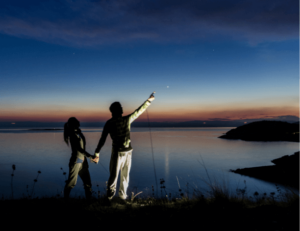 But what if you don’t have anything on hand to help you navigate? You are stuck without a map or compass, and the grid is down so your GPS isn’t working. How would you navigate then?
It’s important to learn how to use both land and sky techniques to find your way in these kind of circumstances. This is how our ancestors roamed the Earth, and you can guide yourself in the same manner.
Let’s start with the sun. This is something that most people know how to do at least minimally. If you look outside during the morning or evening hours, you’ll know that the sun rises in the east and sets in the west, so that gives you a bit of navigational potential.
But what if it’s nighttime and you can’t use the sun? Assuming it’s not cloudy, one can use the stars to navigate you. Just look up and find the North Star to help guide you. Most people can spot the Big Dipper constellation, and this shows you the North Star (which is the last star in the Little Dipper handle).
Of course, these are based on the Northern Hemisphere. There are other instructions for the Southern Hemisphere, but the same benefits apply in using the sky during the day or night to find your way around.
Other Techniques for Navigation
You might have weather that prevents you from adequately using the sky for navigational purposes. If that’s the case, you can still find your way by using landscape to give you clues on where you’re at and where you’re going.
For example, If you find a river, you can follow it downstream to a lower elevation where you may find a town and a larger body of water.
If you take time to learn the geography in your surround location, you’ll be able to recognize things like a mountain range and find your way according to that.
Even the vegetation you come across can give you navigational clues. You might find cattails and realize there’s some sort of water nearby, or it may be a sign of swampland that you need to navigate around.
Sometimes you’ll spot moss growing on trees, and this is something that can help you navigate because moss mainly grows on the north side of a tree, where it’s more shady and damp.
Safe Ways to Master Navigation for the Family
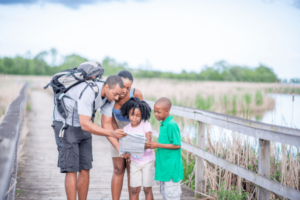 Navigation basics is not something where you simply dole out the compass and maps and assume everyone can make do with those supplies. You have to educate them about how to use them or how to work without them.
Practice is essential, and that practice needs to take place periodically, not just one time. You need to practice during the day, at night and in different weather conditions and locations.
Sometimes, a path that you were able to travel during the spring or summer becomes impassable during the winter or rainy months, so you’ll need to know what to do in that situation and never rely on any one route.
Navigating with Practice
Try starting out from home, then go elsewhere and get dropped off so you can navigate home. Go out in the wilderness and even get on a boat to try nautical navigation a few times.
You can go on hikes and outings with groups where you not only learn navigation, but also foraging efforts simultaneously. Instead, look for a guided survival event like this or hire an individual to show you and your family the ropes.
You also need to know what to do if and when you find yourself lost. Even practiced navigational experts can find themselves in a situation where they’re a bit disoriented and if this happens, you have to be able to not panic and assess where you’re at and where you need to go.
You want to have some steps in place for what you’ll do to figure out your next steps. Panicking and running in the wrong direction could put you in a place of danger. Start by using any gadgets you have.
If it’s a compass or map, check to see if those will assist you in that moment. Some people have had trouble with a compass functioning properly near electrical or metal items, so that may not be operational.
If you don’t have those on hand, look to the sky and land to find your bearings. Look for the sun, stars, water sources, plants that give tell-tale signs of which direction is which, and more.
Keep in mind there are various products you can buy for navigation. A compass doesn’t have to be separately carried in a backpack. You can buy watches that have a built in compass so that you have it at all times.
Wilderness Navigation
Conclusion: Developing Lifelong Navigation Skills
In times of a crisis, having the ability to navigate and find direction is crucial.
By understanding the navigation basics, such as using a compass and reading maps, you can greatly increase your chances of finding safety and help.
Remember to stay calm and think clearly during these situations, as panic can cloud your judgment.
Practice these navigation skills in advance so that they become second nature when faced with an emergency.
With a little preparation and knowledge, you can confidently navigate your way through any crisis. Stay safe and always be prepared!